
FIFA has accepted the goal-line technology after a series of doubtful situations. The technology has been discussed earlier on this blog but is highly relevant once again.

It has been discussed for a couple of years, but now it is a reality; FIFA has approved the goal-line technology. I have earlier expressed my fear for the future of football, if it got to technical and I am still not convinced this is the right solution to the “ghost-goal” problem. However, the EURO 2012 proved to us that adding an extra pair of eyes on the goal did not help on the problem. It was almost humiliating to see how a referee, which only job was to keep an eye on the goal, did not see whether the ball crossed the line. At the moment, the goal-line technology seems to be the only solution. That said, how often do we see a “ghost-goal”? 1 out of a 100 matches?

My fear for the future of football is not whether or not a ball crossed the line. It is the fear that adding one technology to the game will be followed up by another. Michel Platini said, during a press conference that the goal-line technology could be followed up by a ‘technology for offside decisions as well’. Platini is right; this current technology frenzy does not stop with the goal-line. Sooner or later we will have the offside technology, censors telling us if the player committed a foul or even a technology telling the referee whether or not the wall is in the correct distance from the free kick. As the UEFA-president said:

'I am against technology coming into force to actually make decisions’.

FIFA has now opened a door for the technology, and thereby for a new future for football. I can only hope that, at some point, this technology adventure will end, instead of making our beloved passion into a videogame. No matter what, I am going to miss the mystique about whether or not the ball crossed the line, but as humans has done for centuries: I’ll adapt to the changes.

0 kommentarer

The debate about goal-line technology is on its highest after Chelsea’s ghost-goal against Tottenham, last weekend. After match video material leaves no doubt that the ball did not cross the line, and referee Martin Atkinson has later apologized to Tottenham. The world of football screams for goal-line technology, but will it not ruin the spirit of the game?

The idea of goal-line technology sounds great. A chip in the ball will tell the referee whether or not the ball crossed the line, so the ghost-goal phenomenon will never be seen again. It will defiantly bring some more fairness into the game: no more doubts about a goal, no more critics of the referees, no more history…

Think about this: so far there have been nineteen World Cups since 1930. How many of them can you remember the results of or have heard of since they were played? Personally, I can think of two:

The World Cup final in 1966 between England and West Germany, and the round of 16 match between Germany and England. Why? Because of the ghost goals! The 1966 World Cup final is one of the most debated football matches ever and has been under scientific evaluation, in order to find out if the ball was in or not. Alan Ball put in a cross, and Geoff Hurst shot from close range. The ball hit the underside of the cross bar and bounced down on the line and was cleared, however, the referee and his linesman awarded the goal to England.
In 2010, Germany took revenge when they won 4-1 against England. England trailed 2-1 in the first half when Frank Lampard hit the crossbar, and the ball landed about a yard behind the goal-line. However, the goal was not accepted by the referee.

No doubt that both of these situations are examples of unfairness towards the teams ruled against. However, this is what creates football history and what we remember. These moments will be lost if the technology is introduced. I would rather see a goal not been accepted than game where everything is complete and correct. Football needs these moments of doubt and our referee’s end up being slaves of the technology. What if it someday fails? What if someday the ball crosses the line and the referee doesn’t hear the ‘biip’ is his ear. Whose fault is it then? It will put the referee under a new pressure.

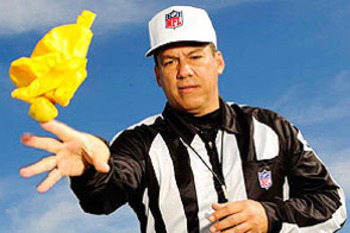
Another subject was brought up this week, by Arsenal manager Arsene Wenger. The French called for referees to be given help of instant video replays in order to avoid players diving. The world of football has seen some rather weak referee performances as well as diving from the players, which could bring them closer to a Hollywood Oscar statuette than a league championship. However, an instant video replay is not solution of the problem. This instantly makes me think of American football conditions. Should the referee run around with a yellow cloth every time he is in doubt of a situation? This will bring unnecessary pauses into the game and irritate the fans. Once again, I would rather give the player and the referee the benefit of the doubt.


What is needed is better education for the referees and harder punishment for the players, if they are diving. Wenger opens for the idea of a disciplinary committee which should be able to rule retrospectively on whether a player has dived. Sound great! Less stopping in the matches than by the use of instant video replay.


However, football fans need that small uncertainty that keeps them on the edge of the seat. If we have a system, telling us whether the ball the ball is over the line or not, or a camera on the sideline for the referee to use whenever he is in doubt, will kill the spirit of the game. Football is a simple game, let’s keep it that way!
0 kommentarer